
Social Value for SMEs: What It Means and Where to Start
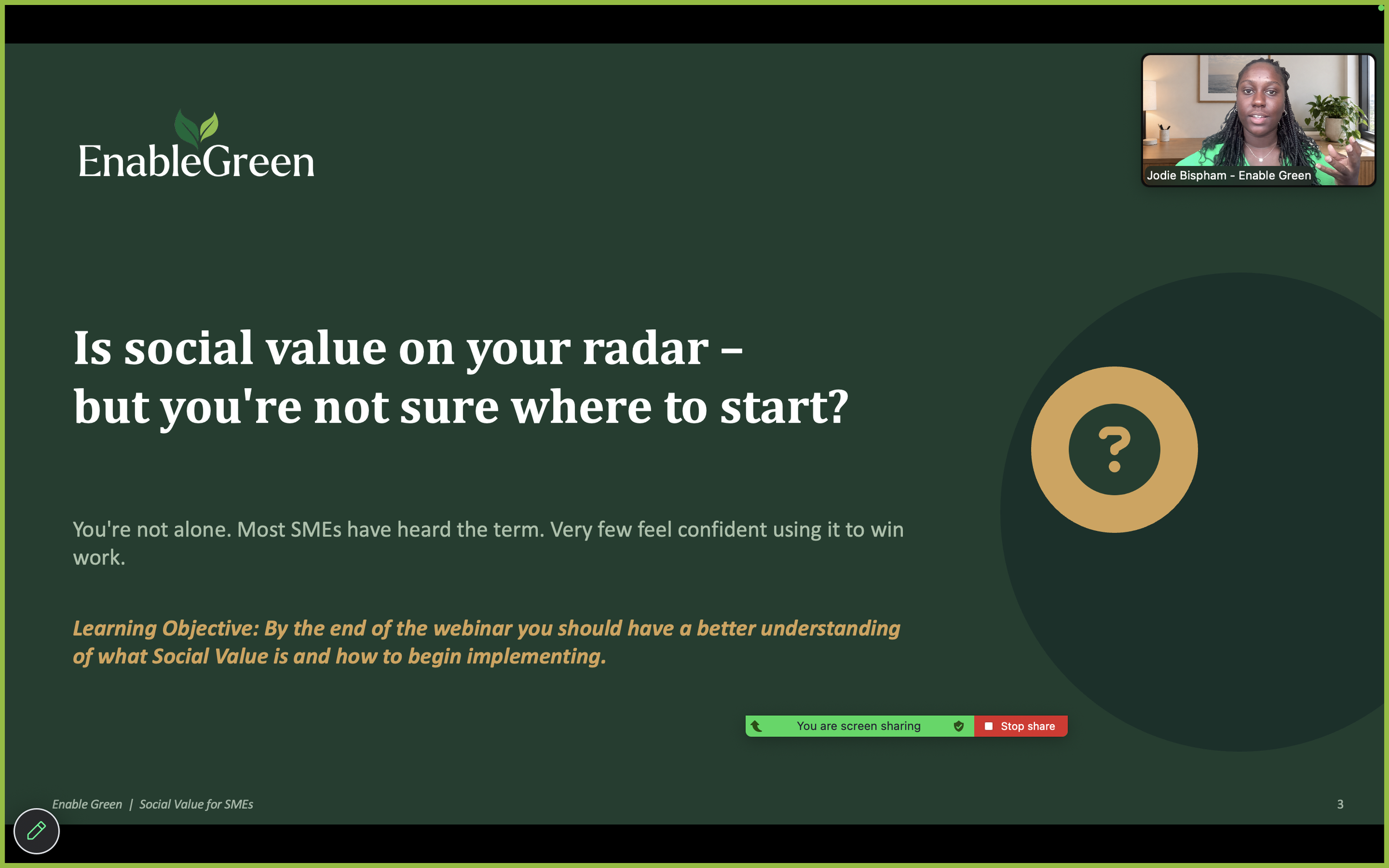
If you run a small or medium-sized enterprise (SME), Social Value may be something you have heard mentioned in tenders, procurement conversations or by larger contractors. However knowing that social value matters and knowing what it actually means for your business are two different things. For SMEs, particularly those working in construction, housing, development, infrastructure and professional services, social value is becoming increasingly relevant to how contracts are won and delivered.
What is important to highlight is that social value does not necessarily mean creating a completely new programme, hiring a dedicated team or taking on another layer of work. In many cases, businesses are already creating social value through the way they employ people, work with suppliers, support communities and manage their environmental impact.
The challenge is recognising, recording, and being able to demonstrate it.
That was the focus of our recent Social Value for SMEs session on 12 September 2026. In this article, we have brought together some of the key points for businesses that are either new to social value or want to take a more structured approach.
Why social value matters now
Social value is not a new concept in public procurement. Since the Public Services (Social Value) Act 2012, it has become progressively more embedded, first through PPN 06/20 and now through the Procurement Act 2023 and PPN 002, which place wider public benefit at the centre of how contracts are awarded and delivered.
The Social Value Act 2012 established a requirement for relevant public authorities to consider how procurement could improve the economic, social and environmental wellbeing of an area.
The Procurement Act 2023 subsequently introduced wider reforms to the public procurement system, with social value continuing to form part of how public contracts can deliver wider public benefits.
The publication of PPN 026 in August 2026, which introduced a new Central Government Social Value Model, is a clear signal that social value is continuing to evolve, with greater emphasis on good jobs, skills and opportunities. For SMEs, understanding how to evidence and measure these contributions will become increasingly important when working within public sector supply chains.
Alongside legislation, frameworks such as the National TOMs have helped organisations structure how social value commitments are identified, measured and reported.
For SMEs, this matters because social value does not stop at the main contractor.
When a local authority, housing association or public body sets social value requirements for a contract, those requirements can flow through the supply chain. Tier 1 contractors may then ask their subcontractors and suppliers to contribute to commitments around employment, training, local procurement, community engagement or environmental outcomes. As a result, social value can become relevant to an SME even when the SME is not bidding directly for a public sector contract.
What is social value?
At its simplest, social value is about considering the wider benefits created by economic activity.
A business is not only delivering a product, service or project. Through that work, it may also be creating jobs, developing skills, supporting local businesses, strengthening communities or improving environmental outcomes.
There is no single activity that automatically creates social value. It depends on the context, the people affected and the outcomes being created.
For SMEs, it can be helpful to think about social value through four broad areas:
Community impact – volunteering, charitable partnerships, community engagement and support for local organisations
Local employment – local recruitment, apprenticeships, work experience, training and fair employment
Inclusive procurement – spending with local SMEs, VCSEs and diverse suppliers and creating opportunities within the supply chain
Environmental outcomes – reducing carbon and waste, improving biodiversity and delivering more sustainable projects
These areas can overlap, and the right priorities will depend on the business, project and requirements of the client.
What does this look like in practice?
For businesses working across the built environment, social value can be closely connected to the work already taking place on projects. A construction company might provide apprenticeships or work experience for local residents. A developer might create local employment opportunities or support a community organisation. A contractor might increase the amount it spends with local suppliers. An infrastructure project might invest in skills, engage with local schools or create opportunities for people who are further from the labour market.
There can also be an environmental dimension, whether that is reducing waste, lowering emissions, improving biodiversity or finding more sustainable ways of delivering a project.
The important point is that social value is not necessarily a separate activity sitting alongside the work. It can be embedded within how a project is delivered. This is particularly relevant for SMEs because they often have strong local connections and can have a direct relationship with employees, suppliers, customers and communities. A smaller business may not have the resources of a large organisation, but it can still create meaningful local impact.
The challenge is often making that impact visible.
The difference between doing and demonstrating
One of the themes that came through strongly during the session was that many SMEs are probably doing more social value than they realise.
A local supplier is not simply another line on a purchase order. That spend may be supporting another local business and helping money remain within the local economy. A work experience placement is not simply 40 hours on a timesheet. It could give someone their first experience of a sector they are considering as a career.
This is where it becomes useful to move beyond simply recording activity and start thinking about outcomes.
Instead of only asking “What did we do?”, ask “What changed as a result?”
That might mean looking at the number of people employed, but also considering whether they gained new skills or progressed into further employment. It might mean recording local spend, but also understanding which businesses benefited and why that matters to the local economy.The distinction is important because a long list of activities does not necessarily tell us much about the difference they have made.
Evidence is what turns an activity into something you can demonstrate
If an SME is asked about its social value contribution in a tender, saying that the business supports the local community is unlikely to be enough. Clients increasingly want to understand what was delivered, who benefited and what evidence exists.
That evidence does not need to be complicated.
It could be an apprenticeship record, training attendance, an invoice showing local procurement, photographs from a community activity, volunteering records, participant feedback or a testimonial from a partner organisation.
The key is to start capturing this information as you go and establishing effective recording and reporting
A simple internal record can make a significant difference. Keeping track of what happened, when it happened, who was involved, the scale of the activity and the evidence available means that information is there when it is needed. Over time, this creates something much more valuable than a collection of individual examples. It creates a picture of the contribution the business is making across its projects and operations.
You do not necessarily need to do more
Social value does not always mean adding more commitments to an already busy business.
Before deciding what else you could do, it is worth looking at what you are already doing.
You may already be employing locally, supporting apprentices, purchasing from smaller suppliers, giving staff time to volunteer or reducing waste across your operations. The first step may simply be to understand those activities better and capture the evidence.
From there, you can start to identify where there are gaps and where additional activity could create meaningful outcomes.
This also helps avoid a common problem with social value: making commitments because they sound good on paper, without considering whether they are realistic or whether they will create meaningful benefits.
The strongest commitments are usually those that connect naturally to the business, the project and the needs of the community.

Making social value part of the way you work
For SMEs, a structured approach to social value can support much more than a single tender response. It can help businesses understand their wider contribution, build stronger relationships with clients and communities, and identify opportunities to create greater impact through work they are already delivering.
It can also make future procurement conversations much easier. Instead of starting from scratch every time a client asks what social value your business can offer, you have a clearer understanding of your existing activity, the outcomes it creates and the evidence behind it.
Frameworks such as the National TOMs can help provide structure and consistency, while approaches such as Social Return on Investment (SROI) can be used where a more detailed assessment of outcomes and impact is appropriate.
The right approach will depend on the organisation, the project and what the client is asking for. Social value should be proportionate and meaningful rather than becoming a box-ticking exercise.
Ultimately, the question for SMEs is not simply “What social value can we add?”
It is also: “What difference are we already making, and how can we demonstrate it?”
If you are an SME looking to understand social value, measure your existing activity or prepare for social value requirements within procurement and supply chains, Enable Green Partners can help you develop a clear, measurable and evidence-based approach.
Get in touch at info@enablegreen.co.uk.
