While businesses often talk about Corporate Social Responsibility (CSR) and Social Value (SV) interchangeably, these concepts, though similar, are not the same. Understanding the distinction could change how your business or organisation approaches impact.

If you work in sustainability, procurement, or social impact, you have most likely heard both terms, CSR and SV, many times. While they sit comfortably in the same sentences, reports, and the same online discourses, they represent meaningfully different things.
What is CSR?
CSR emerged in the 1950s and 60s as a framework for businesses to acknowledge their role in society beyond profit. At its core, CSR is the voluntary commitment of an organisation to operate ethically, consider its environmental footprint, and contribute positively to the communities around it.
When thinking about CSR, the following activities may come to mind: corporate volunteering days, charitable giving, diversity reports, and environmental pledges. But something to note is that CSR is largely inward-facing; it shapes how a company behaves and how it wants to be perceived, as well as its own reputation and social legitimacy.
Key characteristics of CSR: Voluntary in nature. Focused on reputation and ethics. Often activity-based rather than outcomes-based. Reported internally or in annual sustainability reports.
What is SV?
SV is a more specific, outcomes-oriented concept. It refers to the quantifiable, additional benefit that an organisation creates for communities, the environment, and public services - beyond the core product or service being delivered.
In the UK, it has a legal dimension: the Social Value Act (2012). This act requires public bodies to consider SV when procuring goods and services. The Government’s PPN 06/20 has taken this further, mandating that at least 10% of a tender evaluation for central government contracts be weighted on SV.
SV does not just ask: Are you a responsible business? But what specific, measurable difference is your business or organisation making, and how can it be proved? Where CSR can be ad hoc or more reputational, SV operates at a more rigorous level. It considers impact across multiple dimensions. This includes inputs, outputs, activities and outcomes, and requires organisations to move beyond ‘ticking boxes’. The question is not just what your organisation did, but what changed due to this action, and whether it can be evidenced.
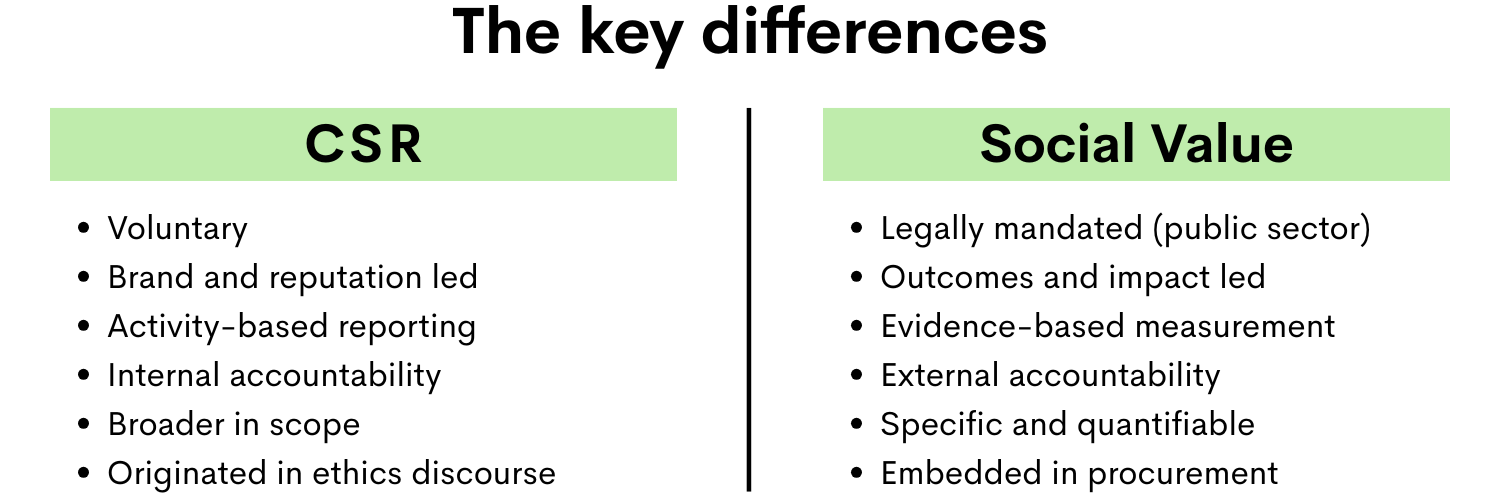
Key characteristics of SV include: Outcomes and evidence-focused. Often tied to public procurement. Measured using recognised frameworks (TOMs, SROI, HACT). Includes social, economic, and environmental impact.
"Any business can say it cares about people and the planet. SV asks you to show your working and demonstrate what changed as a result." - Jodie Bispham, Founder of Enable Green Partners
Where they overlap
CSR and SV are not opposites. CSR provides the values and culture that motivate action, while SV provides the wider strategy and rigour to make that action count.
Many businesses begin their journey with CSR commitments and initiatives and gradually build toward a more structured SV approach as they grow. The two frameworks are complementary when used together.
Why it matters right now

Stakeholders want evidence, not just intention. Supply chains are under scrutiny. Businesses that articulate, deliver, and measure their social value - not just talk about their values - are building trust, deepening community impact, and creating real change. And they are also winning contracts.
The shift from CSR to SV is not about abandoning one for the other. It's about moving from good intentions to accountable, strategic impact. And in today's landscape, that distinction is critical.
Ready to move from CSR commitments to measurable SV?
Enable Green helps organisations design, deliver, and evidence social value that wins work and creates real change. Contact us.